
Interview: Europe Must Build Its Own Path

My interview, entitled Europe Must Build Its Own Path, was published on 15 January 2026 in Vijenac, the literary supplement for art, culture, and science of the Croatian National Association.
The interview was conducted by Kristina Olujić Ježić.
The full interview is published below.
Pavo Barišić, President of the International Pan-European Union
Europe Must Build Its Own Path
Europe can no longer rely on American protection. It must build its own path, strengthen its strategic autonomy, and develop capacities independent of external political changes.
Interview by Kristina Olujić Ježić
Pavo Barišić, President of the Croatian Pan-European Union, has been elected President of the International Pan-European Union, the oldest movement dedicated to the unification of Europe. He received a vote of confidence from Pan-European Members of the European Parliament representing forty organisations from thirty countries at the General Assembly of the International Pan-European Union, held last February at the European Parliament in Strasbourg.
Assuming leadership of the Pan-European Union—following a line of distinguished and charismatic presidents such as Richard Coudenhove-Kalergi, Otto von Habsburg, and Alain Terrenoire—represents a significant recognition for Croatia and its Pan-European orientation. At the same Assembly, Mislav Ježić and Vanja Gavran were elected to the Presidency Council of the International Pan-European Union, with Gavran appointed Secretary General. In this way, the Croatian Pan-European Union joined Germany and France as one of the three most strongly represented national organisations in the leadership of the International Pan-European Union.
Pavo Barišić was born in Gornja Dubica, Bosnia and Herzegovina, in 1959. He graduated from the Faculty of Law in Zagreb in 1982 and from the Faculty of Philosophy in Zagreb in 1983, earning degrees in Philosophy and German Studies. He completed postgraduate studies in the Philosophy of Science at the Inter-University Centre (IUC) in Dubrovnik and obtained his master’s degree from the Faculty of Political Science in Zagreb in 1985. He earned his doctorate in philosophy from the University of Augsburg in 1989 and is an emeritus professor of philosophy at the University of Zagreb.
He served as Minister of Science and Education in the Croatian Government from 2016 to 2017 and as Assistant Minister of Science, Education, and Sport from 2004 to 2006. He is the recipient of numerous awards and the author of several books, most recently Ante Starčević: Ideals of Freedom and Rights (2022).
This interview was conducted on the occasion of a panel discussion organised in December by the Croatian Pan-European Union and the Croatian Diplomatic Club, as well as in anticipation of the forthcoming anniversary of the election of the President of the International Pan-European Union.
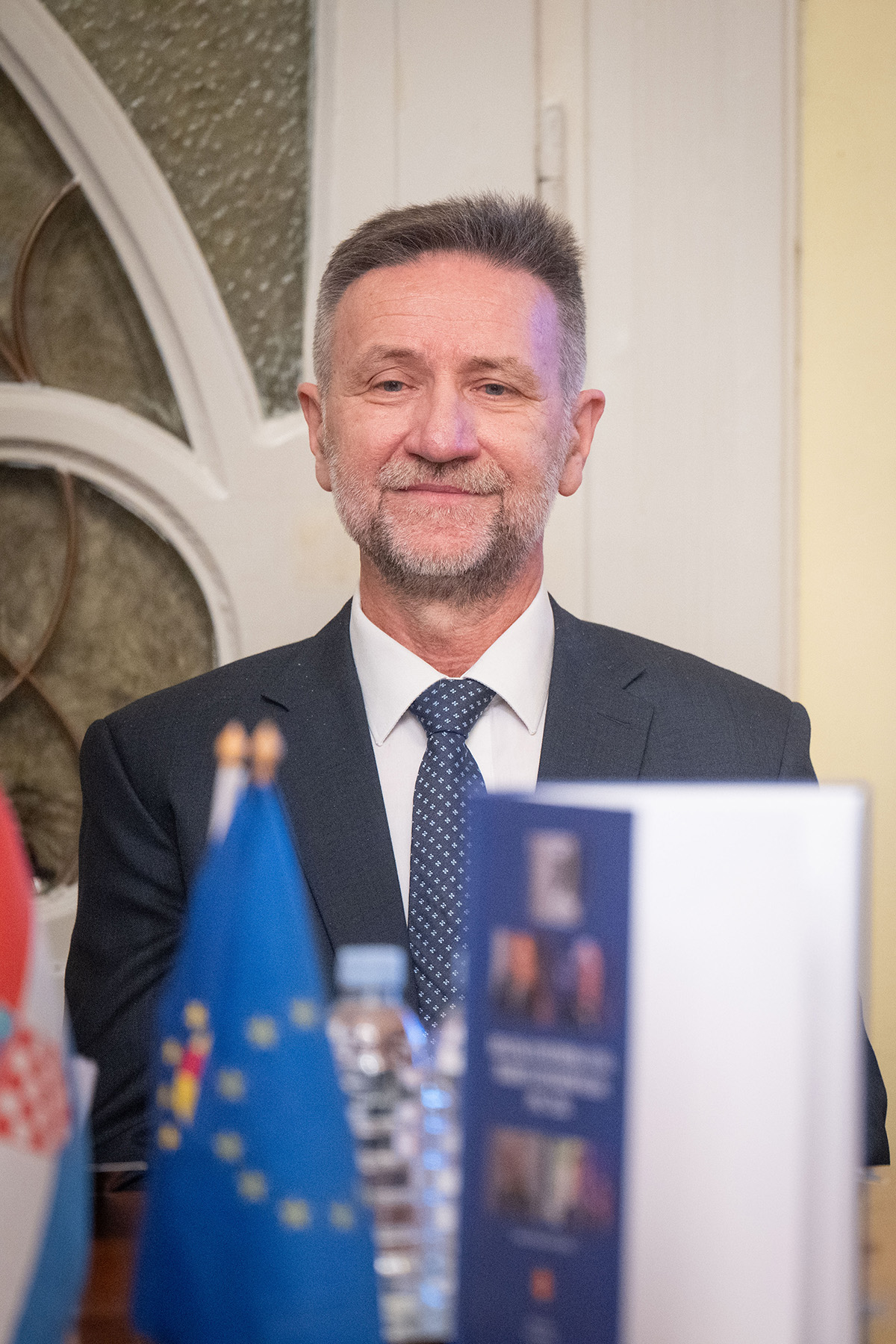
Photo: Neva Žganec / PIXSELL
Your speech at the recent panel discussion The International Pan-European Union and Current Global Challenges resonated strongly. How do you view Europe’s position in today’s geopolitical puzzle?
Europe can no longer rely on American protection to the extent it once did. It must chart its own course, strengthen its strategic autonomy, and develop capacities independent of external political changes. I would like to quote a statement made in 1923 by the founder and first President of the Pan-European Union, Richard Coudenhove-Kalergi, which remains highly relevant today: “Europe has almost lost its self-confidence and therefore expects help from outside: some from Russia, others from America. Both hopes are deadly dangers for Europe. Europe will be saved neither by the East nor by the West: Russia seeks to conquer it, America to buy it. The primary goal of European policy must be to prevent a Russian invasion. There is only one means to achieve this: to unite Europe.”
How strong is the International Pan-European Union today compared, for example, to thirty years ago, and can it serve—as many believe—as a corrective to the increasingly bureaucratised European Union?
It is true that certain institutions within the European Union display an inherent tendency to distance themselves from citizens and towards growing bureaucratisation. The German political philosopher Herfried Münkler has likened this machinery to an overworked rule-maker who governs by means of directives imposed “from above”. In contrast, the Pan-European movement operates “from below”.
It is remarkable in that it never imposed itself or seized power in states, as ideological movements such as socialism, communism, or fascism did. Instead, it has influenced Europe’s long-term political transformation through a peaceful aspiration towards unity and cooperation. In this respect, the International Pan-European Union continues to function as a kind of intellectual “corrective” to political deviations within European institutions.
The symbolism of the red cross on a golden sun in the flag of the IPEU points to two fundamental pillars of European civilisation: Hellenic wisdom, symbolised by the light of Apollo’s sun, and Christian faith, represented by the cross. As regards symbolism, it is worth recalling that Coudenhove-Kalergi already proposed Beethoven’s Ninth Symphony, set to Schiller’s Ode to Joy, as the European anthem at the first Pan-European Congress in Vienna in 1926. A common European currency was likewise proclaimed in the 1923 programme book Paneuropa, from which the name “euro” is derived. These Pan-European visions remain a valuable legacy today.
When discussing the influence of the International and Croatian Pan-European Unions, it is little known that they contributed to the struggle for Croatian independence during the Homeland War and to Croatia’s international recognition. Could you briefly recall their role in this regard?
This contribution is described and documented in greater detail in the commemorative volume of the Croatian Pan-European Union published the year before last on the occasion of its 33rd anniversary. The very date of its founding—27 May 1991—is significant, preceding the Declaration of the Proclamation of the Sovereign and Independent Republic of Croatia of 25 June 1991.
From its very beginnings, the Pan-European Union thus engaged in supporting Croatian statehood and international recognition. Its first President, Mislav Ježić, together with other members, travelled to numerous European countries to Pan-European gatherings, where they appeared in the media, held discussions with influential interlocutors, took part in public rallies in support of Croatia’s recognition, and protested against Greater Serbian aggression. The office of the Croatian Pan-European Union also served as an information hub, disseminating news to the international public about the latest political and military developments, as well as about efforts to resolve the crisis and the war.
You first assumed the presidency of the Croatian Pan-European Union in 2003. During your first term, Croatia became a member of the European Union. What role did the HPEU play during the accession negotiations?
When I assumed the presidency, preparations for negotiations were just beginning. That same year, Croatia submitted its application for EU membership at the initiative of the International President, Otto von Habsburg. While some countries and European institutions were hesitant, and Croatian politicians themselves were uncertain, he helped to clarify perspectives.
When his 90th birthday was celebrated in Zagreb in December 2002, he urged the Foreign Policy Committee of the Croatian Parliament to stop hesitating and finally submit the application. To those committee members who expressed doubts, citing information from their political contacts in European institutions that such a move would not be well received, he responded that they should place greater trust in true friends who wished Croatia well and advocated on its behalf.
Member organisations of the Pan-European Union were tasked with dedicating at least one activity per year to supporting Croatia. This Pan-European engagement was continued by President Alain Terrenoire. Among those deserving particular mention are Bernd Posselt, President of the Pan-European Union of Germany, who played a key role as rapporteur in several European Parliament committees during the negotiations; Ingo Friedrich, Vice-President of the European Parliament, who led the Pan-European working group; and Julien Vanderbeeken, President of the Pan-European Union of Belgium. Much of this work remained largely invisible to the public.
You earned your doctorate in Augsburg under Professor Arno Baruzzi with a dissertation on the philosophy of the world in G. F. W. Hegel, later published in German. During the campaign against you as minister, you were accused of having violated doctoral regulations through the publication of certain works. These accusations were dismissed after a thorough review by the University of Augsburg. Did anyone in Croatia who initiated these accusations ever apologise?
All allegations against my academic integrity were unequivocally rejected by the competent ethics bodies. To my knowledge, the scholars who submitted these unfounded complaints have not publicly apologised, which in itself speaks to their moral integrity. They may need time to recognise the injustice they caused.
As Kant explains, there exists within every human being a remarkable power called conscience. Its operation is not subject to temporal limitation. Repentance for an act may arise long after it has been committed. A person may persuade themselves that they acted unjustly for certain reasons, but the internal accuser does not cease raising objections.
I received satisfaction where I least expected it—on the political front. A former party leader, whose party had unsuccessfully sought my dismissal as minister on the basis of fabricated accusations, apologised to me in front of a larger audience following a public book presentation. He admitted that only later had he realised the extent of the manipulations through which they had been misled into uncritically accepting those defamatory claims.
You worked at the Institute of Philosophy from 1986 to 2019 and served as its director for a full decade (1991–2001). The Institute’s original mission was to research the history of Croatian philosophy. Accordingly, you yourself devoted much attention to Croatian philosophy. Which themes did you pursue?
You have formulated the question well. The Institute of Philosophy was indeed originally tasked with the systematic study of the history of Croatian philosophy. However, after 2001 this mission was gradually marginalised in the Statute. Today, research into Croatian philosophy has been reduced to one of the Institute’s four organisational units.
Fortunately, it still exists, and I am pleased to confirm that it remains one of the most productive departments of the Institute. My research focused on practical philosophy, philosophy of law, political philosophy, and general questions concerning the history of Croatian philosophy in a European context. I studied the philosophy of law of Antun Ferdinand Albely, Ante Starčević, and Ivan Mažuranić.
I served as director of the research programme History of Croatian Philosophy and Fundamental Problems of Philosophy, as a researcher and later as project leader of the National Foundation project Croatian Philosophy and Science from the 12th to the 20th Century. I published several books with the Institute, including Open Questions in the History of Croatian Philosophy and Pavao Vuk-Pavlović: Life and Work. Last year, a monograph I edited on the Institute’s first employee, the distinguished aesthetician and founder of Croatian aesthetics Zlatko Posavec, was published.
You are especially noted for your study and publication of the works of Ante Starčević. What drew you most strongly to Starčević, and why is his thought still relevant today?
The work of the Father of the Homeland stands as one of the most original intellectual achievements by Croatian authors in the field of practical philosophy. His contemporaries recognised this, especially the academic youth, who saw him as a light in the darkness—a Diogenes illuminating Croatian political reality. Matoš and Krleža wrote about him with inspiration.
Matoš described the “Old Man” as a classic not only in education, style, thought, and sympathies, but also in life, comparing him to figures such as Pythagoras, Socrates, and Marcus Aurelius. He regarded him as “our strongest thinker and best publicist”, “a giant who does not fit into the biographies of modern politicians”. Krleža declared Starčević “the most lucid mind among us, who observed our reality with the sharpest insight and rendered it in images of extraordinary literary and rhetorical power for an entire century”.
Awareness of the significance of Starčević’s work persisted across generations, including President Franjo Tuđman, who wrote the foreword to my edition of the first volume of Starčević’s works, Speeches. Unfortunately, Starčević is today neither as well known nor as present as he deserves to be. Numerous prejudices and misunderstandings surround his work, which I sought to clarify.
His case also confirms the ancient saying that it is not easy to be a prophet in one’s own land. Through publishing his works, researching his political ideas, and teaching courses on his philosophy of law, I have therefore sought to make a modest contribution to preserving the memory of a great figure who belongs among the honorary founders of Croatian freedom and republicanism.
Interview (HR) (PDF)